Title Image

Blog

The AI that matters is the one running when you’re not looking

There’s a workflow running right now at a broadcaster you’ve heard of. Assets moving. Deadlines ticking. A QC task that fired three minutes ago is waiting for an error description a human will have to write by hand — because the system that found the problem doesn’t know how to explain it.

Nobody in that room is thinking about how fast they could build a new workflow today. They’re thinking about why this one keeps breaking the same way.

That’s the problem most AI conversations in our industry aren’t having.

Building it is 10% of the job

A lot of energy has gone into making AI useful at build time. Type what you want. Get a workflow. Describe a form. Watch it appear. These are useful capabilities — we’re building them ourselves. But they solve a construction problem, and construction is maybe 10% of a workflow’s operational life.

The other 90% is the workflow running. The media supply chain is the flow of content. The operating layer is what runs it. And it’s in the operating layer that AI earns its place or doesn’t: at 3am when nobody is there, through a file that doesn’t match the expected format, through a QC failure that needs to be diagnosed and escalated rather than just flagged, through an ingestion volume three times Monday’s because a live event just ended.

Most AI in media right now is useful when you’re looking at it. What about when you’re not?

What AI inside a running workflow looks like

When a workflow fails, the platform generates the diagnostic — a description of what happened, what it was trying to do, and where it broke, not a code buried in a log dump. The engineer who picks it up in the morning has context instead of a mystery.

When a new workflow needs documentation, the platform writes it from the existing structure. The kind of documentation someone would produce with two free weeks and nothing else to do — generated in minutes. Undocumented workflows are how institutional knowledge disappears.

When a workflow needs to be created from scratch, a plain-language description becomes a working starting point. The engineer still reviews it, modifies it, owns it. They start with something instead of a blank screen.

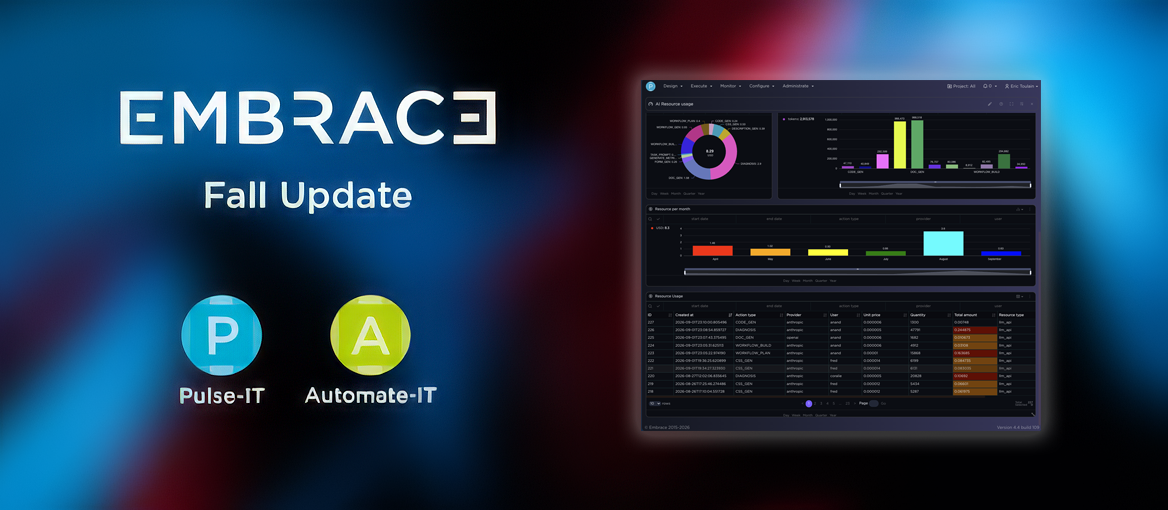
And when AI is consuming resources inside a live workflow, you can see what it costs in real time — per workflow, per task, with the ability to see where usage is spiking and whether it’s worth it. Which model runs, what it costs, when a human steps in: your operations, your rules. Not a surprise when the invoice arrives at month-end.

None of this requires someone to actively use a tool. It’s running. That’s the point.

We could have shipped AI features earlier

The reason we didn’t is the same reason the capabilities we’re showing at IBC are worth looking at: they sit on a workflow engine built for real production conditions, not demo conditions. The kind of workflows Sinclair runs. That TF1 runs. That studios and sports organisations run across the globe.

The magic button — describe your workflow, watch it build — only works if the infrastructure underneath is already solid. The same applies to every AI capability inside live production. If the operating layer doesn’t know what to do with an AI output when it’s wrong, you don’t have AI in your workflow. You have a liability.

We took the time to build the foundation. The AI capabilities in Pulse-IT and Automate-IT connect directly to the forms, workflows, dashboards and analytics components that already exist — ten years of them.

Who this is for

Two people feel this differently.

The workflow builder — the engineer or technical operations person who designs and maintains the supply chain — gets time back. Less time reconstructing logic from dead workflows, writing documentation nobody updates, or diagnosing failures with half the information.

The operations manager — the person responsible for everything running correctly and within budget — gets visibility. What is the AI doing? What is it costing? Is the 2am ingest running the way it should, or is something quietly going wrong?

Most AI tools in this industry talk to one of them. Pulse-IT and Automate-IT talk to both: the builder owns what the AI drafts, and the manager sees what the AI does while it runs.

The AI worth having in media operations is the one already running — explaining its failures, documenting its workflows, and staying visible while it works. That’s what we’ve built, and it’s what we’ll be showing at IBC.

About Embrace

Embrace is the operating layer for media companies, connecting people, technology and processes since 2015. Pulse-IT and Automate-IT enable operations teams to orchestrate, automate and continuously improve complex media operations.

Our products are heavily used 24/7 by leading media groups such as Arte Studio, BCE, Be tv, CANAL+, Disney-ABC News, Euronews, Eurosport, Hearst Networks EMEA, Madison Square Garden Networks, Mediawan Thematics, M6, Mercedes-AMG, NBA, NFL Films, NHL, Omnicom Group, Orange, Red Bee Media, RTL Group, ProSiebenSat1, Sinclair, TF1, TV5MONDE, and Warner Bros. Discovery.

For more information, visit www.embrace.fr.