The human was never absent
Most AI workflow demos this year have a screen in them where the run stops and waits for someone to click. It shows up late in the sequence, after the model has done its part. It gets described as a safeguard – or “Human-In-The-Loop”. The design underneath is older than the AI: automate the path end to end, then find the point where nobody is comfortable any longer and put a person back at it.
That works well enough but it also tells you what order the thing was built in. You can only add back what you took out.
Automate-IT was created in 2015 by one of our founders, a designer who was drowning in versions and built himself a way out. He automated the assembly, the conform, the deliverables, the endless re-export for each channel. What he kept was the trim. When a thirty second promo has to become a twenty, something has to go, and he wanted to be the one deciding what. The rest went to the machine and he stopped thinking about it.
Nobody in 2015 was designing for model governance or for the cost of inference. He was solving the problem at hand. But because the thing was built by someone who still had to do the work, the person doing the work stayed inside the design rather than standing at the end of it, and that shape has survived every version since.
At Embrace we call it inclusion. It is architectural rather than a feature, and the difference shows up when you try to change something. Where a person is an exception handler, their judgement lives in whatever the automation couldn’t finish, undocumented and impossible to move. Where they are a step with a name, you can reassign it, audit it, hand it to whoever is on shift, or ask what it costs.
This matters more now than it did last year, because the same question is arriving about models. AI is entering these pipelines the way people already sit in them, acting inside the run rather than around it, and an operations team needs to be able to say which model ran and what it cost. The line we use internally is that you run the AI and not the other way around, and the only reason we can say it without blushing is that nothing had to be reopened or redesigned to make it true.
None of this makes the retrofit wrong. A gate added late still catches things, and plenty of good operations run on parts that were added late. The catch is that a patch belongs to whoever applied it. Someone has to remember why it’s there, and that someone tends to leave.
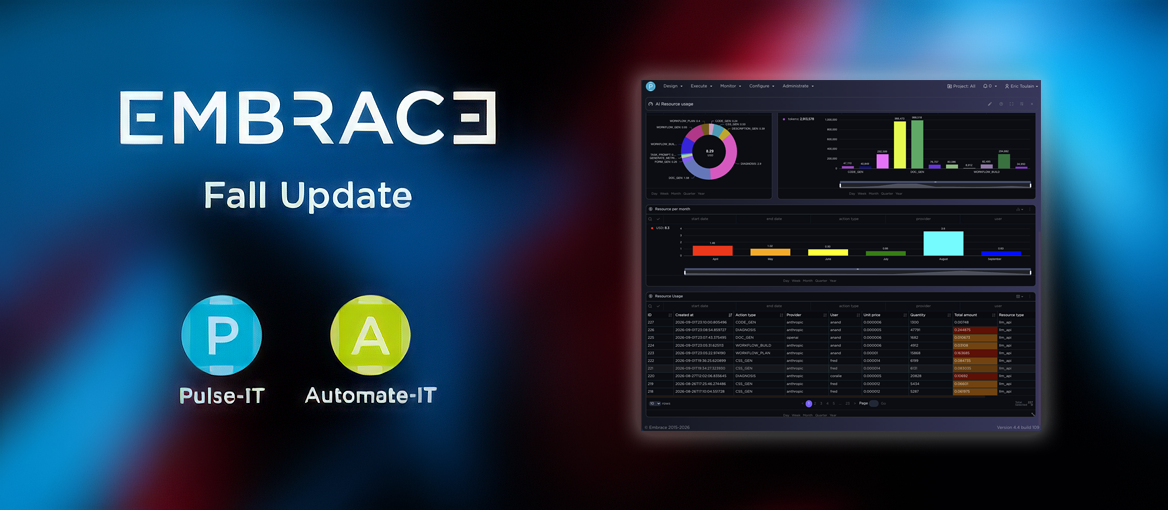
What we’re doing between now and the end of the year is making sure every place a person decides something inside Pulse-IT and Automate-IT can be pointed at and priced. Not because the judgement needs proving, but because an operation that can’t name where its decisions happen can’t move them, cost them, or defend them.
Embrace is the operating layer for media, running at major broadcasters and studios worldwide.
About Embrace
Embrace is the operating layer for media companies, connecting people, technology and processes since 2015. Pulse-IT and Automate-IT enable operations teams to orchestrate, automate and continuously improve complex media operations.
Our products are heavily used 24/7 by leading media groups such as Arte Studio, BCE, Be tv, CANAL+, Disney-ABC News, Euronews, Eurosport, Hearst Networks EMEA, Madison Square Garden Networks, Mediawan Thematics, M6, Mercedes-AMG, NBA, NFL Films, NHL, Omnicom Group, Orange, Red Bee Media, RTL Group, ProSiebenSat1, Sinclair, TF1, TV5MONDE, and Warner Bros. Discovery.
For more information, visit www.embrace.fr.