Why can’t you see what your workflows cost?
Most operational damage in media doesn’t announce itself. A cost leak can run for a quarter before finance notices, and a compliance risk tends to surface the day after it mattered. When someone finally asks what a workflow actually did, the answer can take three people an afternoon to reconstruct, because the evidence is scattered across people, systems, audit trails and logs buried several layers deep.
None of that is technical failure. Every system involved may have worked exactly as built. The operation was simply running without enough operational visibility, and nobody could see the problem clearly until something went wrong loudly enough to notice.
The uncomfortable part is that you can automate a process you can’t really see, and plenty of teams have. The workflow fires and the job completes. Somewhere, the logs can probably tell you what happened. But turning those logs into an answer — what happened, why, what it cost, what decision was made and who needs to act — is still an investigation. Automation without visibility isn’t control — it’s a faster version of not knowing.
That becomes even more important as workflows become agentic. When agents can make decisions as well as execute steps, knowing that something ran is no longer enough. You need to understand what it decided, why, and what happened next.
Consider what operating means anywhere else in a business. A finance team that couldn’t see its own spending wouldn’t call itself in control, and a factory that couldn’t see its own throughput wouldn’t call itself running. Yet media operations is often held to a different standard, where a workflow is allowed to remain a black box as long as it mostly works, and the cost of the times it doesn’t gets quietly absorbed.
Visibility is the precondition for control
You can’t operate what you can’t see. You can’t budget for it, govern it or improve it either. The verb changes with the conversation, but the underlying problem doesn’t: control starts with knowing what the operation is doing while it is doing it.
And visibility doesn’t mean another monitoring screen. Monitoring tells you whether systems are alive. Operational visibility tells you whether the operation is producing the outcome the business expects.
When the operation is visible, the sequence reverses. The leak shows up while it’s still small enough to be boring, and the risk surfaces before the deadline instead of after it. Reconstructing what happened stops being a research project, because the workflow explains itself. The question shifts from what happened to what to do about it.
That’s the difference between having a media supply chain and operating one. The supply chain moves the content. The operating layer lets you see what the operation is doing, what it costs and where attention is needed to meet the business goals.
Start with what you can see. Everything else in operations depends on it.
About Embrace
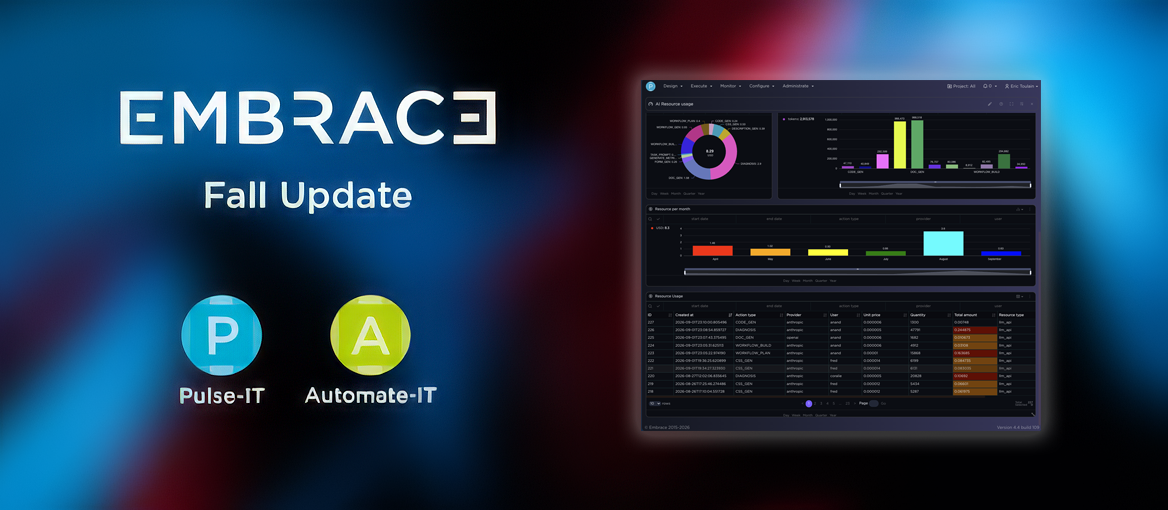
Embrace is the operating layer for media companies, connecting people, technology and processes since 2015. Pulse-IT and Automate-IT enable operations teams to orchestrate, automate and continuously improve complex media operations.
Our products are heavily used 24/7 by leading media groups such as Arte Studio, BCE, Be tv, CANAL+, Disney-ABC News, Euronews, Eurosport, Hearst Networks EMEA, Madison Square Garden Networks, Mediawan Thematics, M6, Mercedes-AMG, NBA, NFL Films, NHL, Omnicom Group, Orange, Red Bee Media, RTL Group, ProSiebenSat1, Sinclair, TF1, TV5MONDE, and Warner Bros. Discovery.
For more information, visit www.embrace.fr.